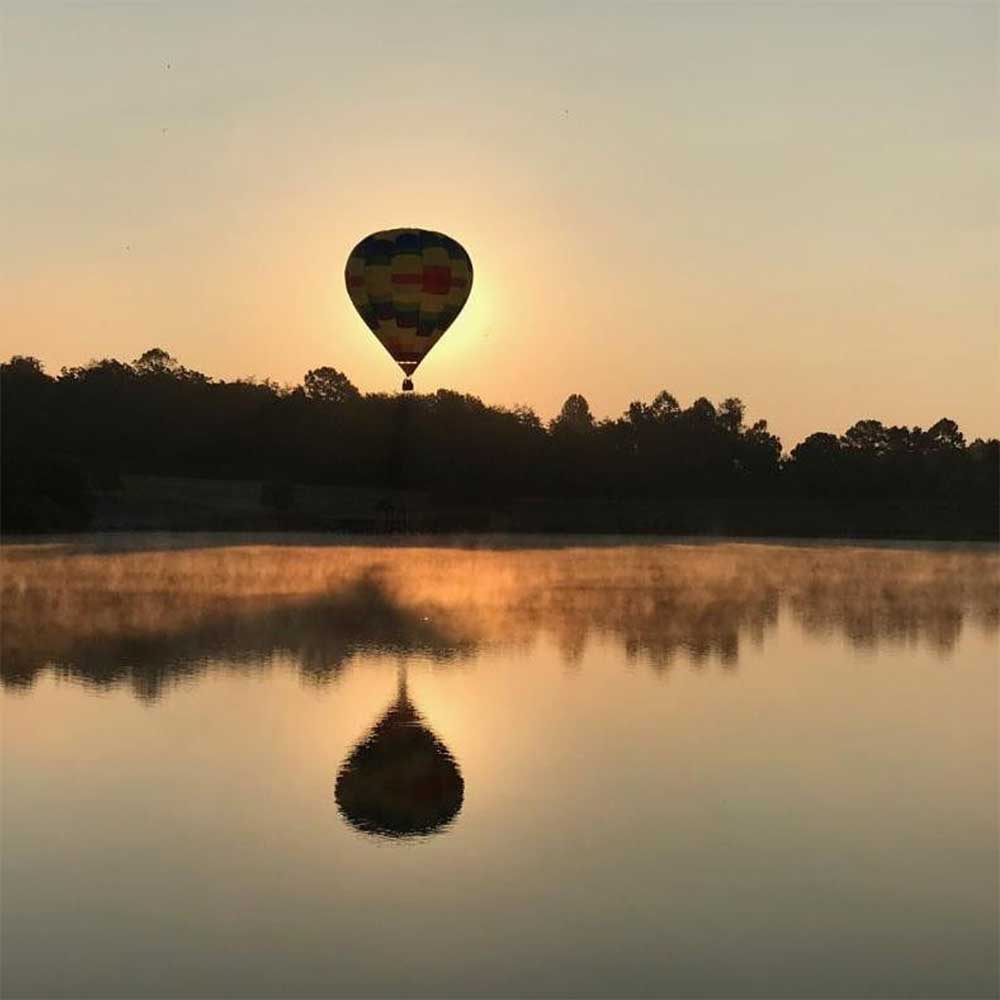
Our journey begins at dawn. As we scout the perfect launch site, we release a "pibal" — a small helium balloon — to read the invisible currents of the upper atmosphere. This tells us wind speed, directional variability, thermal activity, and turbulence at the altitudes we'll fly. It's the most accurate tool a pilot has, and the true final decision maker for every flight.
02
Preparation
Inflation & Launch
02. Inflation & Launch
Inflation & Launch
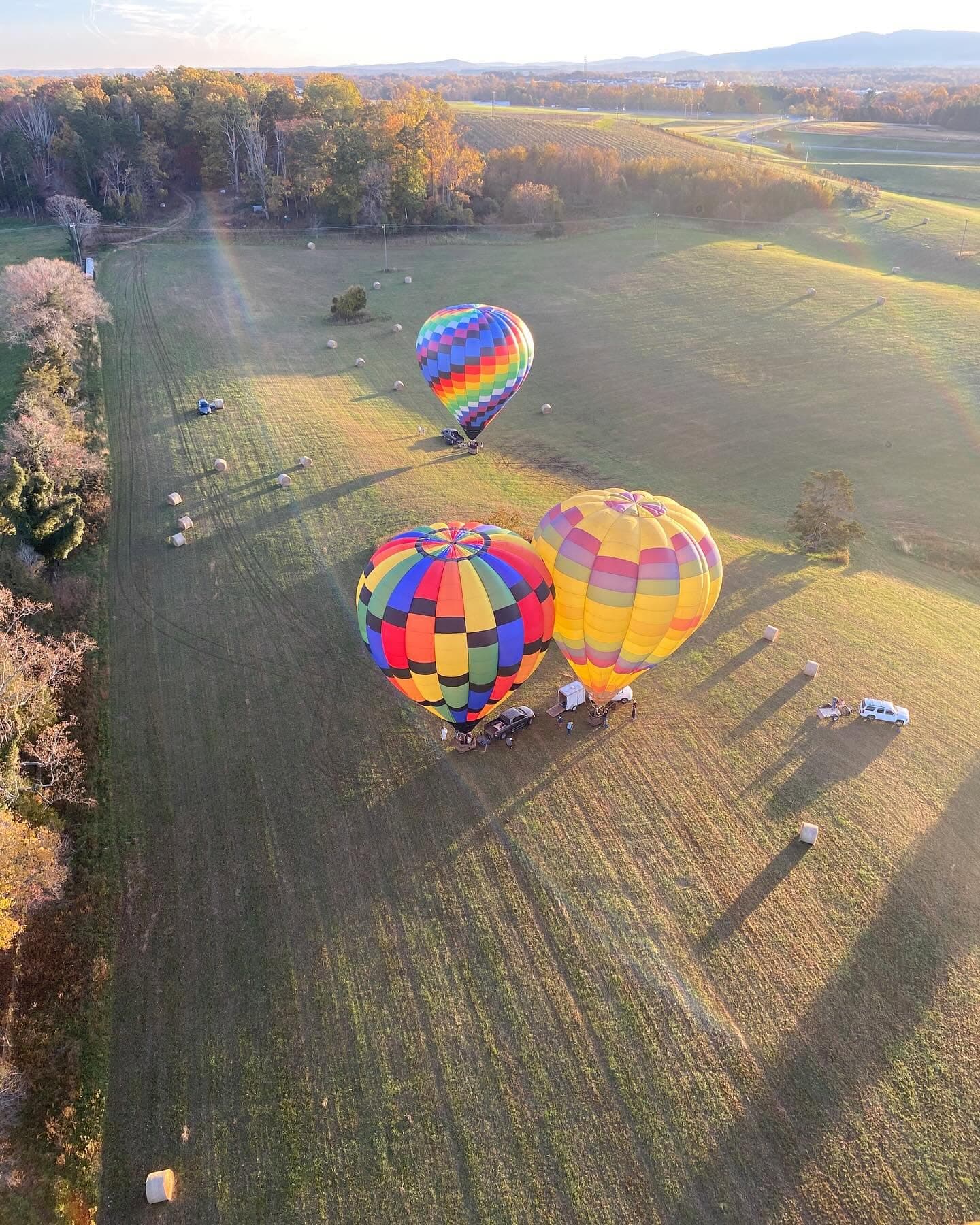
Witness the giant envelope come to life. A portable fan pushes cold air into the balloon, then the propane burners ignite — illuminating the colorful fabric against the morning twilight. In about 20 minutes, the balloon rises to an upright position and becomes buoyant. You'll help with the process, then climb aboard for liftoff.
03
In Flight
Aerial Virginia
03. Aerial Virginia
Aerial Virginia
Floating silently over the Blue Ridge Mountains, you'll drift over historic estates, rolling countryside, rivers, and lakes. The world feels still from a thousand feet. Mandy controls altitude within inches using the burner, catching different wind currents at different heights — "a little bit like sailing, but there's no tacking."
04
Tradition
Champagne Toast
04. Champagne Toast
Champagne Toast
Upon landing, we celebrate with a traditional champagne toast (or sparkling cider). Our chase crew captures your flight from the ground with digital photography, and we present your personalized flight certificates. The entire experience — from meeting to return — takes about 2.5 to 3 hours, with 45 to 60 minutes in the air.
Flight Details
The finer details of your journey
Sunrise & Sunset
We offer sunrise flights daily, year-round. Sunset flights are available by request. Morning flights are recommended at all times of the year due to calmer conditions and more reliable weather.
Meeting Time
Varies by month — see our monthly schedule on the Rates page
Unrivaled Views
✓ Blue Ridge Mountains
✓ Shenandoah Valley
✓ University of Virginia
✓ Historic Piedmont Estates
✓ Rivers, Lakes & Countryside
All-Inclusive
No hidden fees. Every booking includes:
📷 Digital Photos🏆 Flight Certificate🍾 Champagne Toast🚗 Transportation
👕
What to Wear
Dress in layers. The temperature in the air is the same as on the ground. Flat, closed-toe shoes are required. Waterproof footwear for morning flights.
⏰
Time Commitment
Plan for 2.5 to 3 hours total. This includes the drive to the launch site, setup, 45-60 minutes of flight time, pack-up, and the champagne toast.
👪
Passenger Info
Best suited for ages 8 and up. Passengers must be able to stand for the duration of the flight and climb into the basket. Weight restrictions apply — see our Rates page for details.
Frequently Asked Questions
Why should I fly with Monticello Country Ballooning?
We offer the only all-inclusive package in the area — our rates already include tax, digital photographs, and the traditional champagne toast (or beverage of your choice). Transportation to and from the launch site is included with private flights. We also offer special safety and comfort features like padded floors and tanks in our baskets for soft landings, turning vents on the balloon for better positioning, and enough seating and seatbelts for all passengers in the chase vehicle. We employ the most experienced pilots and crew in the area and maintain a perfect safety record.
When is the best time to fly?
Hot air ballooning is a year-round activity. Conditions are best just after sunrise and about 2 hours before sunset, when light winds (0-8 mph) are most common. Our busiest seasons are spring and fall due to the foliage. Morning flights are recommended over afternoon flights at all times of the year due to overnight atmospheric cooling and stabilization, making these flights much more likely to happen and having better conditions. This is especially true during winter/early spring and the hot summer months when most afternoon flights get canceled due to heat, humidity, and thunderstorms.
Are there restrictions for afternoon flights?
Yes. As afternoon flights are often breezier with rougher landings and the basket is harder to get into, all passengers must be under age 70, in good physical health, and capable of climbing into the basket unassisted. There are no age restrictions on morning flights when takeoff and landings are generally much calmer.
What should I wear?
The air temperature during the flight is about the same as on the ground, so don't overdress. Wear casual outdoor attire like jeans and sneakers — not your best clothes. Dresses, skirts, sandals, and high heels are not recommended. We suggest waterproof footwear for morning flights since grass can be wet with dew, a baseball cap and sunglasses for summer flights (the burner puts off quite a bit of radiant heat), and a jacket or sweater for cooler times of the year.
How long is the ballooning experience?
Airtime usually ranges from 45-60 minutes. Morning flights tend to be longer (closer to an hour), while afternoon flights tend to be a little shorter (closer to 45 minutes). From the time we pick you up to returning to the meeting location, plan on 2.5-3 hours total. The extra time includes driving to the launch site (15-20 minutes), balloon assembly and inflation (20-30 minutes), the flight itself, packing up (~30 minutes), the champagne toast, and transport back.
Where do you launch?
We have many launch sites in and around the Charlottesville area depending on wind speed and direction. Since launch site selection is entirely based on conditions that day, locations cannot be predetermined or guaranteed. The final decision is made on the field to provide a safe and scenic flight path. If you're staying in the Charlottesville area, our meeting sites are usually within 10-15 minutes from where you are staying.
Where do balloons land?
Since a balloon travels with the wind, it's not possible to determine an exact landing site prior to launch. However, a pilot is able, through the study of wind currents, to determine the general direction of the flight. We have been flying in the Charlottesville area for over two decades and are the only pilots local to the area — we're quite familiar with the flying territory.
How do pilots steer the balloon?
Generally speaking, we don't — a balloon drifts in the same direction and at the same speed as the wind. The skill is for the pilot to pick the altitude that has the most desired wind direction. We can control the balloon's vertical height to within inches, but the horizontal "steerage" comes from the wind. Surface winds sometimes blow in a very different direction from the winds aloft. It's a little bit like sailing, but there's no tacking.
Can anyone pilot a balloon?
Balloon pilots must have an aircraft pilot's license specifically for balloons, issued by the Federal Aviation Administration (FAA). This is earned after taking hours of instruction with a balloon pilot instructor, passing an FAA written test, making a solo flight, and passing a flight test with an FAA examiner. The entire process must be repeated to earn a Commercial pilot's license.
Are there age or weight restrictions?
Children under 8 are generally not great candidates for a balloon ride — they're often not tall enough to see over the basket edge, are startled by the sudden sound of the burner, and may not have the attention span for an hour-long flight. Due to the nature of ballooning, weight restrictions apply and can vary by season based on heat and humidity. If combined weight for a couple is over 375 lbs, you may reserve for a group sunrise flight or a private sunset flight. If combined weight exceeds 400 lbs, please contact us prior to making a reservation. Over 425 lbs combined, we're happy to accommodate you on a private flight.
How are balloons inflated?
The balloon envelope is spread on the ground and the gondola laid on its side and attached to the envelope cables. A portable gasoline-powered fan pushes cold air into the envelope. When it's about half inflated with outside air, a propane burner is ignited until the air inside is heated enough for the balloon to rise to an upright position. With a small amount of additional heat, the balloon becomes buoyant. Typically, the inflation takes about 20 minutes.
How do balloons work?
Hot air rises — the envelope traps a large bubble of hot air. If the air in the envelope is heated by a burner, the balloon will rise. If the air is allowed to cool or is vented from the top or side of the envelope, the balloon will descend. An altimeter, a rate-of-climb meter, and an envelope temperature gauge are the only instruments used. Amazingly, the pilot can control the altitude within a matter of inches!
What kind of fuel do balloons use?
Common liquid propane gas (LPG) is used to heat hot air balloons. Propane is carried in liquid form under pressure in stainless steel tanks and supplied to the burners through flexible hoses. The burner flame may shoot out 6 to 8 feet. A typical 1-hour flight with 3 people aloft consumes about 20 gallons of propane. Our balloon system has two independent burner and fuel systems for added safety.
How do you decide if it's safe to fly?
As FAA commercially rated pilots, we gather and evaluate weather-related information along with over two decades of local knowledge and experience. Before we fly, we release a "pibal" (pilot balloon) — a small helium-filled balloon that we track at the altitudes we'll potentially be flying at. The pibal shows us wind speed, directional variability, thermal activity, wind shear, and turbulence. We may release several pibals for your flight. The pibal is the most accurate representation of conditions at flying altitude, and is the true final decision maker.
How many people does it take to fly a balloon?
Safely launching and flying a balloon requires a minimum crew of two — the crew chief and the pilot. Our crew handles launch preparation, follows the balloon flight in the chase vehicle, obtains permission from landowners for landing and retrieval, keeps spectators out of the landing area, and ensures property is not damaged.
How much does a balloon cost?
The average balloon system may range from $20,000 to well over $40,000. This includes the envelope, gondola, burner, fuel tanks, and instruments, but does not include any ground support equipment. Our envelope weighs 267 lbs with approximately 475 lbs loaded basket weight.
Can we take photos?
Absolutely! Bring your camera or phone for aerial shots. Our chase crew also captures your flight from the ground — digital photographs are included in every package at no extra charge.
What is your cancellation policy?
As part of our 72-hour cancellation agreement, if you need to cancel or change your reservation, please let us know 72 hours in advance. Your spaces are reserved specifically for you — a late cancellation fee of 100% will be charged for any reason within 72 hours of your flight time. We're happy to accommodate necessary changes with appropriate notice and always work to avoid charging the fee when possible. The sooner we know, the more likely we can help!
Ready for Your Flight?
All-inclusive packages from $600/couple. Sunrise flights daily, year-round.